Two archives that were searched exhaustively for one thing and never searched again for anything else.
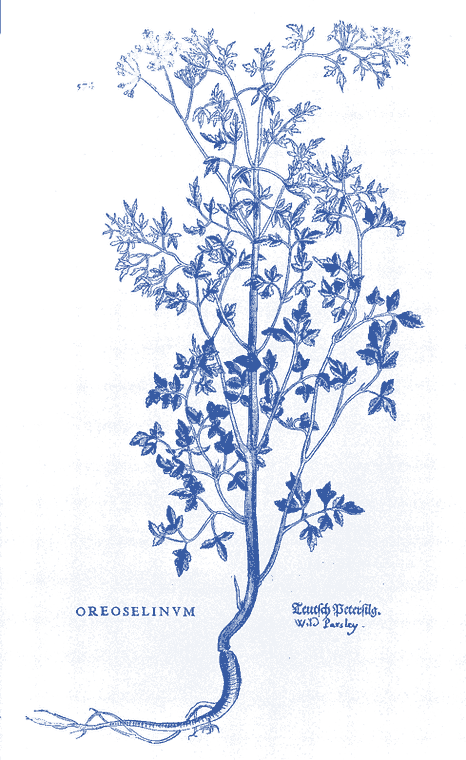
Oreoselinum. Leonhart Fuchs, De Historia Stirpium, 1542.
ere the archive is biological. Public sequence repositories hold enormous quantities of data deposited to answer one question and never revisited, and pre-modern pharmacological literature holds several centuries of careful observation that modern screening simply walked past because it was written in the wrong language and the wrong century.
Neither of these has been near a laboratory and neither will be. There is no wet-lab validation behind any of it, which is the single most important thing to say about both. What exists is a screening argument, not a finding.
The Work
Cryptobiome
Active
Mining public sequence archives for cold-active enzymes, unusual gene clusters and ancestral antimicrobial peptides.
Three threads run in parallel: cold-active enzymes out of assembled genomes and marine metagenomes, biosynthetic gene clusters in phyla that have barely been looked at, and antimicrobial peptides reconstructed from paleoproteomic data. Candidates are screened on identity thresholds and checked for novelty against the standard reference sets so that anything already known drops out early.
What existsA large pipeline across the three sub-domains with a candidate log of 45 records. Every candidate is computational. Nothing has been expressed, assayed or validated in any way, and the identity-threshold screen is a filter rather than evidence of function.
Materia
Active
Reading pre-modern pharmacological archives for bioactive compositions modern screening skipped.
The sources are the great colonial-era compendia, Ainslie in 1826, Watt in 1889, Dymock in 1890, alongside expired pre-1950 chemistry patents. These record preparation, dose, indication and observed effect at a level of detail that would be unpublishable now, across a materia medica that was never systematically screened once the pharmaceutical industry settled on synthesis.
What existsA document-and-data corpus rather than a codebase: 111 notes, one script, and a hits log from the sub-engine that reads the pharmacopoeias. Same caveat as above and it matters more here, because historical efficacy claims are exactly the kind of thing that reads as evidence and is not.
 ere the archive is biological. Public sequence repositories hold enormous quantities of data deposited to answer one question and never revisited, and pre-modern pharmacological literature holds several centuries of careful observation that modern screening simply walked past because it was written in the wrong language and the wrong century.
